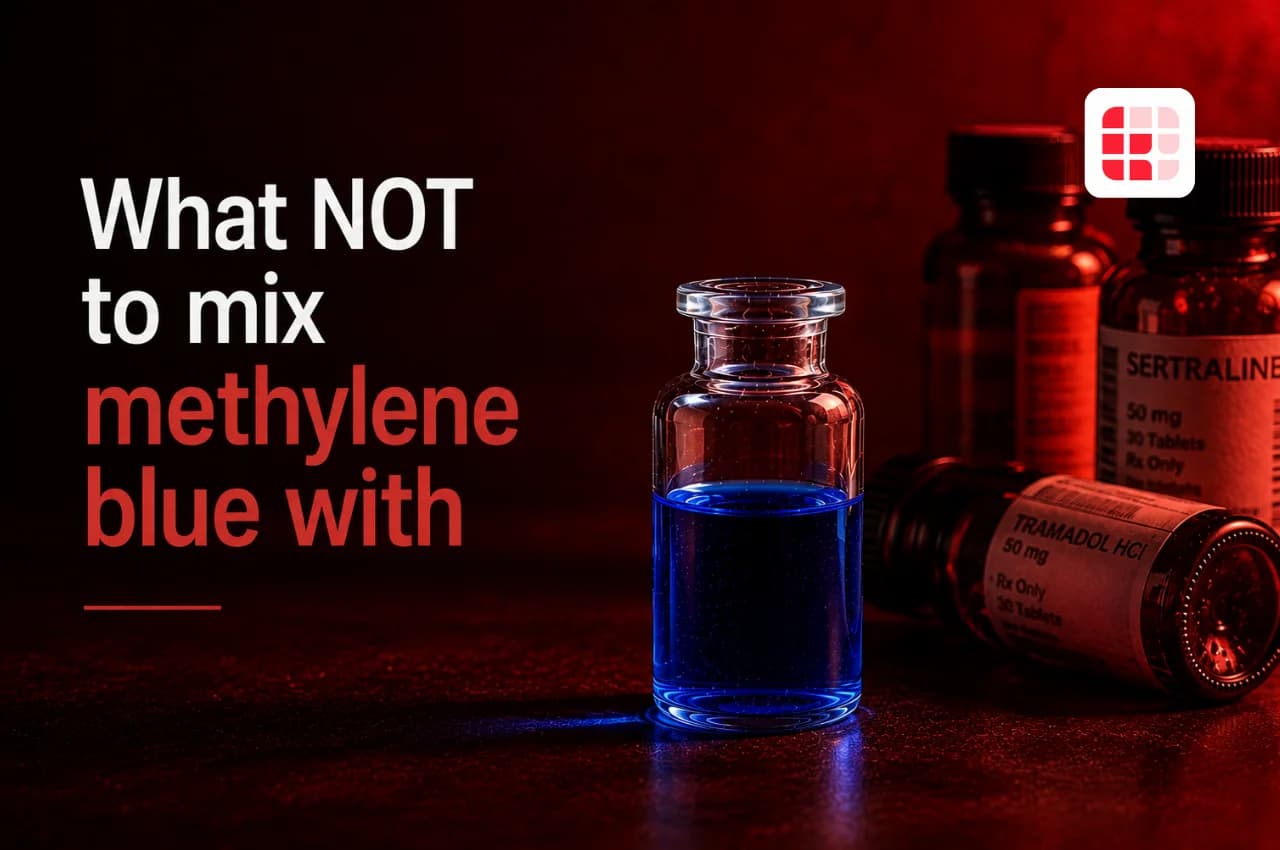
Deep navy still life of a methylene blue vial beside amber medication bottles under cobalt editorial lighting
The interaction that matters most: antidepressants and serotonin syndrome
If you take only one thing from this briefing, make it this: methylene blue behaves as a potent monoamine oxidase inhibitor (an MAOI) at the kinds of doses people ask about, and combining an MAOI with serotonergic medications can trigger serotonin syndrome. That is a documented, potentially serious medical event, not a theoretical footnote. The U.S. Food and Drug Administration has issued a safety communication specifically warning about this combination. This article is educational and is not medical advice, so treat the pages that follow as a reason to talk with your doctor or pharmacist, not a substitute for that conversation.
The medications of greatest concern are the ones that raise serotonin activity: SSRIs (such as sertraline, fluoxetine, escitalopram), SNRIs (such as venlafaxine, duloxetine), other MAOIs, tricyclic antidepressants, certain migraine drugs known as triptans, tramadol, and some others. Serotonin syndrome can present as agitation, confusion, rapid heart rate, high blood pressure, muscle rigidity, tremor, sweating, and fever, and it can escalate quickly. Because the list of serotonergic drugs is long and easy to overlook, do not try to sort out your own regimen. Bring a complete medication and supplement list to a clinician before methylene blue enters the picture.
Why the MAOI mechanism creates so many interactions
Monoamine oxidase is the enzyme that normally breaks down monoamine neurotransmitters, including serotonin. When methylene blue inhibits that enzyme, serotonin is cleared more slowly. On its own that is one thing, but layer it on top of a drug that is already pushing serotonin higher and the two effects stack. That stacking is the core reason a single compound can interact with such a wide range of medications: the risk is not about any one pill, it is about the combined serotonergic load on your system.
This same mechanism is why timing and dose come up in clinical discussions. Some serotonergic drugs linger in the body for weeks after the last dose, so a recent stop does not always mean the interaction risk is gone. Sorting out washout periods, dose thresholds, and whether a given drug even counts as serotonergic is genuinely a clinician's job. The honest takeaway is that the MAOI property makes methylene blue interaction-prone in ways that are hard to eyeball, which is exactly why a pharmacist review is worth the trouble.
Coffee, caffeine, and alcohol: what the evidence actually supports
These are among the most common questions, so here is the honest answer. There is no well-established, dangerous interaction between methylene blue and normal amounts of coffee, caffeine, or alcohol in the way there is with serotonergic medications. Caffeine is a stimulant that works largely through a different pathway (it blocks adenosine receptors), so a morning coffee is not the interaction to worry about. It is worth remembering that older MAOI medications carry dietary cautions of their own, which is one more reason to ask a professional rather than assume the rules are identical.
Alcohol deserves a slightly more measured note. There is no classic dangerous interaction at normal intake, but heavy drinking stresses the same cellular and metabolic systems, including the liver, and it is broadly counterproductive to anyone paying attention to cellular energy in the first place. So the practical framing is this: caffeine and moderate alcohol are not the headline safety issue, and it is a mistake to overstate a caffeine interaction. The medication interactions, above all serotonergic drugs, are the real story. If you have a specific health condition or take any prescription, run even the everyday stuff by your doctor.
Who should be especially cautious or avoid it entirely
A few groups face elevated risk that is separate from the antidepressant issue. People with G6PD deficiency, an inherited enzyme condition, should avoid methylene blue because it can trigger hemolysis, the breakdown of red blood cells. Anyone who is pregnant or nursing should avoid it or, at minimum, not use it without a doctor's explicit guidance. People with significant kidney concerns or a known sensitivity to the compound also warrant a professional's input before anything else.
Beyond those categories, the safe default for everyone else is still a conversation, not a self-assessment. Quality, purity, and concentration vary widely across products, and dosing questions sit outside what any article can responsibly answer. If you fall into one of the higher-risk groups, or you simply are not sure, that uncertainty is itself the signal to check with a clinician first. Nothing here is a diagnosis or a recommendation to start, stop, or change anything.
The bottom line: talk to your doctor or pharmacist first
The single most reliable safety step is also the simplest: before combining methylene blue with any medication, especially antidepressants, review it with a doctor or pharmacist who can see your full picture. Bring a complete list of every prescription, over-the-counter product, and supplement you take. A pharmacist can screen for serotonergic interactions in minutes, and that screen is far more trustworthy than any checklist you piece together on your own. This is educational information, not medical advice, and it cannot account for your individual health.
To recap the priorities in order: the serotonergic medication interaction is the one that can become a genuine emergency and deserves your full attention. G6PD deficiency, pregnancy, and nursing are clear reasons to avoid it or seek guidance. Coffee, caffeine, and moderate alcohol are not the main event, though moderation is always sensible. When in doubt, do not guess. Ask a professional, and let their read of your specific situation guide what happens next.
Related reading
This article is for educational purposes and is not medical advice. Statements have not been evaluated by the Food and Drug Administration. Consult a healthcare professional before starting any supplement, especially alongside prescription medication.