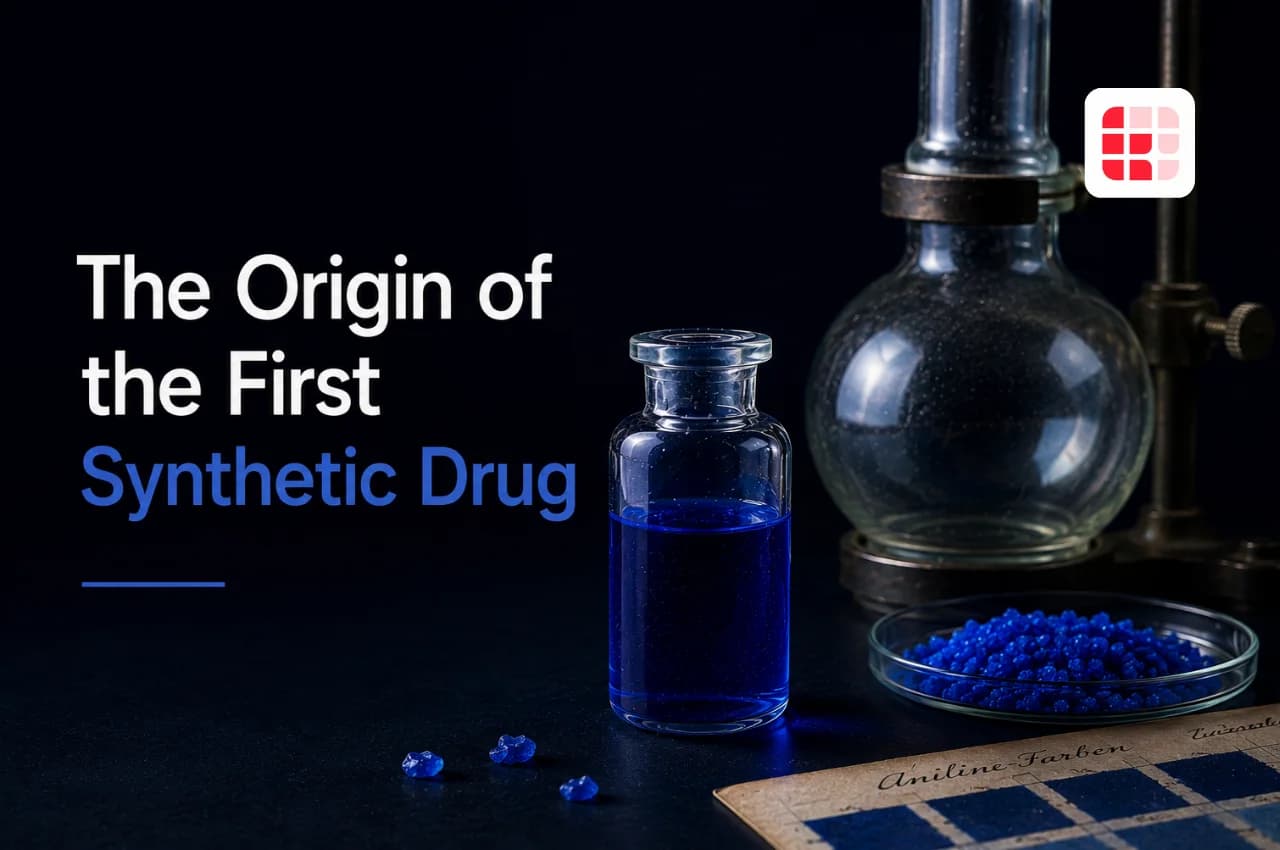
A vial of deep blue methylene blue solution beside antique laboratory glassware on a dark navy surface, lit like a scientific still life
A dye that became a drug
If you have ever wondered how long methylene blue has been around, the short answer is roughly a century and a half. It was first synthesized in 1876 by the chemist Heinrich Caro, who was working at the German firm BASF, and it was created for an entirely practical reason: the textile industry wanted a vivid, colorfast blue for dyeing cotton. Methylene blue was one of the new aniline dyes, a family of synthetic colors built from coal tar chemistry that transformed manufacturing in the late nineteenth century. In other words, its origin has nothing to do with medicine. It began life as an industrial pigment.
That industrial beginning is the key to understanding the compound. Methylene blue is a fully synthetic molecule, which means it was designed and assembled in a laboratory rather than extracted from a plant or mineral. When people ask where methylene blue comes from, the honest answer is a chemistry bench in 1870s Germany. What makes its story unusual is what happened next. A dye invented to color fabric turned out to have a striking affinity for living tissue, and that single property opened the door to biology and medicine.
Who discovered it, and who saw its potential
Caro is credited with first synthesizing methylene blue as a dye, and BASF patented it. But the figure most associated with its scientific career is Paul Ehrlich, the German physician and researcher who worked with the compound through the 1880s and 1890s. Ehrlich was fascinated by the way certain dyes would stain some cells and structures while leaving others untouched. Methylene blue was one of his favorites precisely because it was so selective. He used it to make previously invisible features of cells and microorganisms visible under the microscope, work that helped lay the groundwork for modern histology and staining technique.
So the answer to who discovered methylene blue depends on what you mean. Caro discovered how to make it. Ehrlich discovered what it could reveal. That distinction matters, because Ehrlich's staining research led directly to a bigger idea. If a dye could seek out and bind to specific cells, perhaps a compound could be aimed at a specific target inside the body. This line of thinking is often described as the seed of modern chemotherapy, the notion of a chemical that goes where you send it.
The first fully synthetic medicine
Around 1891, methylene blue crossed the line from laboratory stain to bedside medicine. Ehrlich and his colleague Paul Guttmann studied it as a treatment for malaria, and it was used clinically for that purpose. This is the moment that earns methylene blue a permanent place in history: it is generally recognized as the first fully synthetic drug ever used in humans. Everything before it, from quinine to morphine, had been derived from natural sources. Methylene blue was different because it was a molecule that existed nowhere in nature until chemists built it.
That is a remarkable arc for a substance that was invented to dye cloth. Within fifteen years of its creation, it had moved from the loom to the microscope to the clinic. When people ask when methylene blue was invented, 1876 is the date for the dye, and the early 1890s marks its debut as a medicine. The same molecule spanned three different worlds, and it did so faster than almost any compound of its era.
Still in use, still on the shelf
Methylene blue never became a historical footnote. It remains in clinical use today and appears on the World Health Organization's Model List of Essential Medicines, the catalog of drugs considered most important for a functioning health system. In hospitals it is used to manage methemoglobinemia, a condition in which the blood cannot carry oxygen effectively, and it serves as a surgical stain and diagnostic marker because of that same tissue affinity Ehrlich exploited more than a century ago. Its long, documented record of clinical use is one reason researchers keep returning to it.
The compound you can trace back to 1876 is, chemically, the same one on hospital carts now. That continuity is unusual. Most nineteenth century remedies were abandoned as science advanced, yet methylene blue kept finding new roles. Understanding its history helps explain why it is treated as a well-characterized, familiar molecule rather than a novelty, and why its documented uses are described so precisely in medical references.
Why the history matters to the modern conversation
Much of the recent interest in methylene blue centers on low-dose research into mitochondria, the structures inside cells that produce energy, and on questions about focus and cognitive function. This research is ongoing, and it is best understood as an exploration of mechanisms rather than a set of settled conclusions. What the history adds is context. This is not a brand-new substance that appeared overnight. It is a molecule with roughly one hundred and fifty years of documented chemistry and clinical observation behind it, which is a large part of why it draws careful scientific attention.
As always, history and mechanism are not the same as personal medical advice. Methylene blue interacts with certain medications and conditions, so anyone taking SSRIs or MAOIs, anyone with G6PD deficiency, and anyone who is pregnant or nursing should talk with a doctor before using it. The story of where methylene blue came from is a genuinely fascinating one, from a German dye works to the WHO essential medicines list, and knowing that story is a good foundation for asking better questions.
Related reading
This article is for educational purposes and is not medical advice. Statements have not been evaluated by the Food and Drug Administration. Consult a healthcare professional before starting any supplement, especially alongside prescription medication.